Agencies

Drug Enforcement Administration (DEA)

dea logo

Drug Enforcement Administration: Organization Synopsis

The Drug Enforcement Administration (DEA) is a federal law enforcement agency operating under the U.S. Department of Justice. Established in 1973, its primary mission is to enforce the controlled substances laws and regulations of the United States. The DEA targets the illegal production, distribution, and financial operations of domestic and international drug trafficking organizations. Beyond its traditional law enforcement duties—which include dismantling cartel networks, seizing illicit assets, and preventing the diversion of legally prescribed medications—the DEA also plays a critical role in public health by investing in demand reduction. Through proactive community outreach, it aims to reduce drug use by educating the public about the severe risks associated with illicit narcotics and emerging drug threats.

For those seeking reliable information about the hazards of drug abuse, the DEA provides a vast, highly practical network of resources. Students and young adults can access platforms like Just Think Twice or the Campus Drug Prevention site to learn the scientific facts about addiction, read true stories from peers, and develop critical refusal skills. Parents and caregivers are heavily supported through the Get Smart About Drugs initiative, which features invaluable tools such as the “One Pill Can Kill” fentanyl awareness campaign, guides to decoding emoji drug slang, and comprehensive Parent Toolkits designed to help initiate life-saving conversations at home. Meanwhile, researchers, educators, and public health professionals benefit from the DEA’s extensive intelligence data, including the Operation Prevention curriculum developed with Discovery Education, forensic laboratory analysis on emerging synthetic threats, and up-to-date statistics on global drug trends.

The Drug Enforcement Administration: Enforcement and Regulation

The Drug Enforcement Administration (DEA) serves as the premier federal agency responsible for enforcing the controlled substances laws of the United States. Its approach to drug investigation and enforcement centers on identifying, disrupting, and dismantling major transnational drug trafficking organizations and cartels. By coordinating with local, state, and international law enforcement partners, the DEA executes complex operations to seize illicit assets and halt the flow of illegal narcotics. Fueling these operations is the agency’s robust illicit drug intelligence network. The DEA continuously gathers, analyzes, and shares critical data regarding global drug trends, clandestine manufacturing methods, and trafficking routes. This intelligence-driven approach allows the agency to proactively combat rapidly evolving public health and safety threats, such as the proliferation of illicit fentanyl and other synthetic drugs.

Beyond tackling the illegal drug trade, the DEA plays a critical regulatory role in controlling pharmaceutical substances. To prevent the diversion of highly addictive prescription medications—such as legally manufactured opioids and stimulants—into the illicit market, the DEA maintains a strict “closed system” of distribution. This involves issuing registrations to and continually monitoring all manufacturers, distributors, pharmacies, and medical practitioners authorized to handle these substances. Through meticulous auditing and regulatory enforcement, the agency works to ensure that there is an adequate, uninterrupted supply of controlled medications for legitimate medical and scientific needs, while investigating and penalizing those who exploit the legal supply chain.

National Institute on Drug Abuse (NIDA): Organization Synopsis

The National Institute on Drug Abuse (NIDA) is a federal scientific research institute operating under the National Institutes of Health (NIH). Established in 1973, NIDA is the world’s largest funder of biomedical research on drug use and addiction. Its core mission is to advance the science of addiction—treating it as a chronic, treatable medical condition rather than a moral failing—and to apply that knowledge to improve individual and public health. By strategically funding and conducting clinical, epidemiological, and behavioral research, NIDA seeks to identify the neurobiological causes and consequences of substance use, develop innovative prevention strategies, and discover new therapeutic treatments to combat addiction.

National Institute on Drug Abuse NIDA logo png, AI generated

For those seeking reliable, science-based information about the hazards of drug abuse, NIDA provides a comprehensive and highly accessible resource network. Students and educators can utilize specialized Parents & Educators materials, such as the Mind Matters series, interactive videos, and science-aligned lesson plans that explain exactly how different substances impact the developing adolescent brain. Parents are supported with customized toolkits, including practical conversation starters, guides for recognizing the signs of substance misuse, and direct links to treatment locators. Meanwhile, researchers and public health professionals benefit from NIDA’s vast Clinical Trials Network, extensive open-access datasets (such as the Adolescent Brain Cognitive Development Study), and robust funding programs designed to accelerate the real-world implementation of evidence-based addiction treatments.

The National Institute on Alcohol Abuse and Alcoholism (NIAAA), a component of the National Institutes of Health (NIH), is the lead federal agency for conducting and supporting research on the causes, consequences, prevention, and treatment of alcohol-related problems. As outlined in the NIAAA Strategic Plan, the organization focuses on a broad spectrum of research ranging from the molecular effects of alcohol on the brain to large-scale clinical trials and public health interventions. By funding approximately 90% of U.S. alcohol-oriented research, the NIAAA serves as the definitive scientific authority on how alcohol use impacts human health and well-being across the lifespan.

niaaa logo

For students, parents, and researchers, the NIAAA acts as a high-integrity bridge between complex laboratory science and practical, everyday safety. Students and young adults can utilize targeted resources like College Drinking Prevention and Facts About Teen Drinking to understand the biological risks of underage consumption and binge drinking. Parents are provided with evidence-based guides to help navigate difficult conversations with their children and recognize early warning signs of Alcohol Use Disorder. For researchers and healthcare professionals, the institute offers a wealth of Alcohol Facts & Statistics and specialized tools like the Alcohol Treatment Navigator, ensuring that any investigation into substance hazards is backed by the most current peer-reviewed data and clinical standards.

dare logo

The Drug Abuse Resistance Education (D.A.R.E.) program is a global non-profit initiative, established in 1983, that partners with law enforcement to deliver substance abuse prevention education directly in school classrooms. Originally rooted in the “Just Say No” era, the organization has significantly evolved its approach from lecture-based warnings to the evidence-based “keepin’ it REAL” curriculum. This modern framework, developed in collaboration with Pennsylvania State and Arizona State Universities, focuses on social-emotional learning (SEL) to help students navigate the complex social pressures associated with drugs, gangs, and violence. By utilizing specially trained, uniformed police officers as instructors, D.A.R.E. aims to humanize law enforcement while providing students with a structured decision-making model to assess risks and handle peer pressure effectively.

For students, parents, and researchers, D.A.R.E. provides a unique bridge between community safety and educational development. Students benefit from interactive role-playing and the REAL acronym—Refuse, Explain, Avoid, and Leave—which gives them practical, rehearsed scripts for high-pressure situations. Parents are supported through dedicated modules that offer guidance on improving family communication, recognizing the early signs of substance use, and reinforcing the lessons taught in school at home. For researchers and educators, the organization’s shift toward scientifically validated curricula like keepin’ it REAL provides a case study in how large-scale social programs can adapt to new data. While historical critiques centered on the program’s long-term efficacy, the contemporary D.A.R.E. focuses on broad life skills, including cyberbullying prevention and mental health awareness, making it a multifaceted resource for modern youth advocacy.
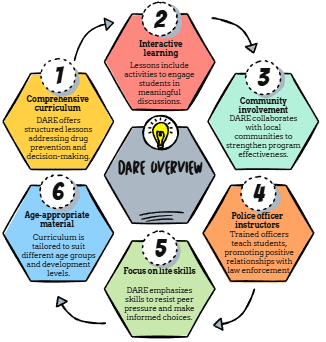
untitled diagram

The Office of National Drug Control Policy (ONDCP) is a high-level component of the Executive Office of the President responsible for leading and coordinating the nation’s multi-agency drug control efforts. Established by the Anti-Drug Abuse Act of 1988, the ONDCP’s primary mandate is to develop and oversee the National Drug Control Strategy, a comprehensive blueprint aimed at reducing illicit drug use, manufacturing, and trafficking. By managing a multi-billion dollar budget and coordinating across 19 federal agencies, the ONDCP bridges the gap between public health initiatives—such as addiction treatment and prevention—and law enforcement actions intended to disrupt the supply of dangerous substances like fentanyl and prescription opioids.

For students, parents, and researchers, the ONDCP serves as a vital clearinghouse for evidence-based information and strategic resources. Students and parents can benefit from the office’s public awareness campaigns and programs like the Drug-Free Communities (DFC) Support Program, which empowers local coalitions to prevent youth substance use through community-specific strategies. Researchers and policy analysts can utilize the ONDCP’s extensive data supplements and research reports to track national trends in drug-related health consequences, overdose statistics, and the effectiveness of various intervention models. By providing a centralized “whole-of-government” perspective, the ONDCP helps stakeholders understand not just the hazards of drug abuse, but also the systemic federal response designed to combat the evolving overdose epidemic.

Overview of the UNODC

The United Nations Office on Drugs and Crime (UNODC) is the global leader in the fight against illicit drugs, international crime, and terrorism. Established in 1997, the office serves as the guardian of the United Nations Conventions on drug control and transnational organized crime. Its mission is to make the world safer from drugs and crime by providing integrated support to member states. The UNODC operates through three primary pillars: field-based technical cooperation projects to enhance the capacity of states to counteract illicit drugs, research and analytical work to increase knowledge of drug and crime issues, and normative work to assist states in the ratification and implementation of relevant international treaties. By coordinating a “whole-of-planet” response, the UNODC addresses the entire supply chain of the world drug problem—from cultivation and trafficking to prevention and treatment.

For students, parents, and researchers, the UNODC is an unparalleled repository of science-based information and educational tools. Researchers can delve into the World Drug Report, an annual publication that provides the most comprehensive global assessment of drug markets, trends, and health consequences. Parents and educators can utilize the Listen First initiative, which provides evidence-based materials designed to support the healthy development of children through effective caregiving and communication. Furthermore, students can engage with the Youth Initiative, a platform that empowers young people to lead prevention efforts in their own communities using factsheets that debunk common myths about substance use. By bridging the gap between high-level policy and grassroots education, the UNODC provides the reliable data and practical skills necessary to navigate the hazards of drug abuse in a globalized world.

Overview of the Department of Homeland Security’s Role in Drug Control

The Department of Homeland Security (DHS) plays a critical, security-focused role in the nation’s fight against drug abuse by targeting the supply chains that bring illicit substances into American communities. Unlike agencies focused primarily on health or education, DHS leverages its massive operational components—specifically U.S. Customs and Border Protection (CBP) and Immigration and Customs Enforcement’s Homeland Security Investigations (HSI)—to interdict drugs at ports of entry and dismantle the transnational criminal organizations (TCOs) responsible for trafficking. By utilizing advanced non-intrusive inspection technology and specialized canine units, DHS prevents billions of lethal doses of synthetic opioids, such as fentanyl, from reaching the domestic market, thereby addressing the “hazards of drug abuse” at their international and industrial source.

For students, parents, and researchers, DHS provides a unique “law enforcement and security” perspective that complements traditional health-based data. Researchers can access detailed seizure statistics and operational reports that illustrate the evolving tactics of drug cartels and the emergence of new chemical precursors. Parents and educators can benefit from the Blue Campaign, which, while focused on human trafficking, often intersects with drug exploitation, providing resources to help recognize the signs of youth exploitation and “dark web” illicit marketplaces. By exploring the DHS’s multi-agency approach, stakeholders gain an understanding of how national security infrastructure is used to mitigate the physical availability of dangerous drugs, providing a comprehensive view of the federal strategy beyond just treatment and prevention.

seal of the u.s. department of homeland security.svg
Overview of SAMHSA

The Substance Abuse and Mental Health Services Administration (SAMHSA) is the lead federal agency within the U.S. Department of Health and Human Services (HHS) tasked with advancing the behavioral health of the nation. Established by Congress in 1992, SAMHSA’s mission is to reduce the impact of substance abuse and mental illness on American communities by providing leadership, resources, and evidence-based policies. The agency operates through specialized centers, such as the Center for Substance Abuse Prevention (CSAP) and the Center for Substance Abuse Treatment (CSAT), which focus on reducing the misuse of illegal drugs, alcohol, and tobacco while expanding access to high-quality recovery services. Unlike law enforcement agencies that target drug crime through interdiction, SAMHSA addresses the “hazards of drug abuse” as a public health crisis, focusing on trauma-informed care, overdose prevention, and the integration of behavioral health into primary medical care.

For students, parents, and researchers, SAMHSA serves as a comprehensive “one-stop shop” for both immediate help and long-term data. Parents and students can access practical tools like the “Talk. They Hear You.” campaign, which provides age-appropriate conversation starters about the dangers of drugs and alcohol. For those in crisis, SAMHSA manages the National Helpline (1-800-662-HELP) and FindTreatment.gov, allowing families to locate verified local treatment facilities anonymously. Researchers and policymakers rely on SAMHSA’s National Survey on Drug Use and Health (NSDUH), which provides the gold-standard annual data on national trends in substance use disorders and mental health. By bridging the gap between scientific research and community application, SAMHSA empowers all stakeholders with the evidence-based knowledge necessary to prevent drug misuse and support lasting recovery.
substance abuse and mental health services administration text logo

Federal Bureau of Investigation (FBI): Organization Synopsis

The Federal Bureau of Investigation (FBI) is the principal domestic intelligence and federal law enforcement agency of the United States, operating under the Department of Justice. While agencies like the DEA are single-mission entities dedicated entirely to narcotics, the FBI is charged with enforcing more than 200 categories of federal law. In the realm of drug enforcement, the FBI focuses heavily on transnational organized crime, public corruption, narco-terrorism, and large-scale trafficking networks. Utilizing an “enterprise theory of investigation,” the agency targets entire criminal syndicates—tracking illicit finances, dismantling supply chains, and seizing assets—rather than focusing solely on individual offenders. Through joint task forces, the FBI actively works alongside local and international partners to cut off the supply of dangerous narcotics, like fentanyl and methamphetamine, before they saturate communities.

For those seeking information about the hazards of drug abuse, the FBI provides sobering, high-impact educational resources. Students and educators can utilize the Chasing the Dragon documentary—a powerful film co-produced with the DEA specifically for high school curricula—that features unfiltered accounts from individuals battling opiate addiction to deter early experimentation. Parents can use the film’s accompanying discussion guides and recent FBI awareness campaigns, such as those highlighting the lethal dangers of purchasing counterfeit pills on the darknet, to initiate critical conversations about fentanyl and prescription drug misuse at home. Meanwhile, researchers and criminologists can leverage the FBI’s extensive open-source crime data, joint task force press releases, and intelligence reports to study the broader systemic impacts of drug trafficking, gang violence, and transnational organized crime.

Scroll to Top